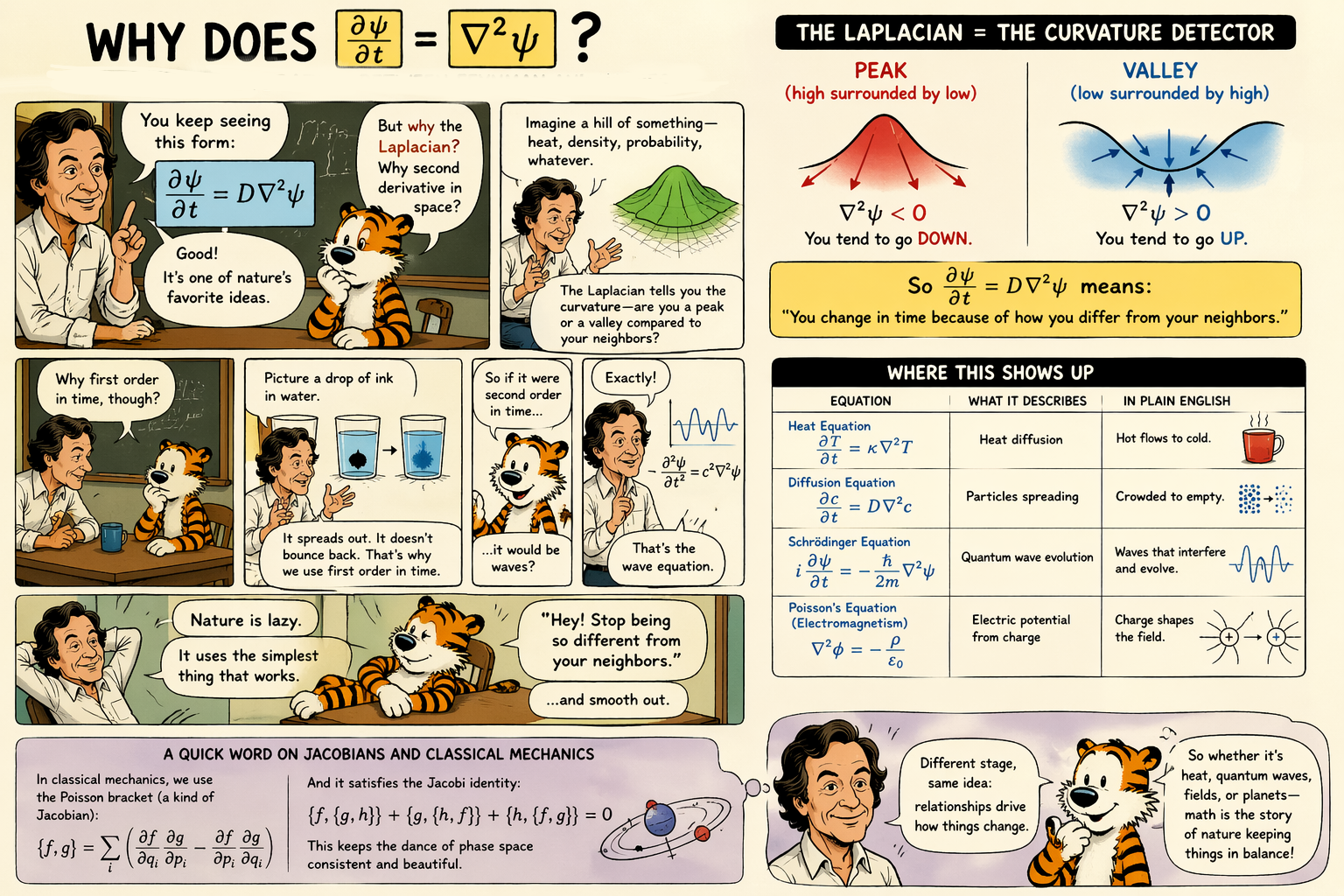
Feynman and Hobbes on the Laplacian — the best physics teachers in the room.
Look closely at the Heat Equation, the Diffusion Equation, and the Schrödinger Equation. They describe completely different physical situations — temperature spreading through metal, ink dissolving in water, electrons behaving like waves. And yet they all share the exact same mathematical shape:
On the left: how fast something is changing in time. On the right: a quantity called the Laplacian — a second derivative in space. Why does this same structure keep reappearing across all of physics? And what does the Laplacian actually mean?
What the Laplacian Actually Means
The Laplacian $\nabla^2$ is a neighborhood comparison tool. At every point in space, it asks one simple question:
Picture a hilly landscape and imagine standing at different spots:
- On a peak: every neighbor is lower than you. The Laplacian is negative: $\nabla^2 \psi < 0$. The value at your point will decrease — the peak erodes.
- In a valley: every neighbor is higher than you. The Laplacian is positive: $\nabla^2 \psi > 0$. The value at your point will increase — the valley fills.
- On flat ground: your neighbors are at the same level. The Laplacian is zero: $\nabla^2 \psi = 0$. Nothing changes. The system is in balance.
That is the entire intuition. When the Laplacian is nonzero, the physics wants to correct it.
What the Equation Is Actually Saying
Put the Laplacian on the right-hand side of a time-evolution equation and you get the Heat Equation:
In plain English, this says:
A very hot spot surrounded by cool neighbors loses heat quickly. A point at roughly the same temperature as its surroundings barely changes at all. The system is always pushing toward uniformity — always erasing the difference between a point and its surroundings. This logic applies equally to ink dissolving in water, a drug spreading through tissue, and the probability of finding a quantum particle. The physical quantities differ. The mathematical structure is identical.
The Same Skeleton, Across All of Physics
| Physics Area | Equation | What ψ Represents | Intution |
|---|---|---|---|
| Heat Conduction | $\dfrac{\partial T}{\partial t} = \kappa \nabla^2 T$ | Temperature | Hot regions cool; cold regions warm |
| Diffusion | $\dfrac{\partial C}{\partial t} = D \nabla^2 C$ | Concentration | Dense regions spread into sparse ones |
| Quantum Mechanics | $i\hbar \dfrac{\partial \psi}{\partial t} = -\dfrac{\hbar^2}{2m} \nabla^2 \psi$ | Probability wave amplitude | The wave function evolves and interferes |
| Brownian Motion | $\frac{\partial \rho}{\partial t} = D \nabla^2 \rho$ | Probability of position | A particle’s likely location spreads out |
The Fundamental Synthesis
Flux law: $\mathbf{J} = -k \nabla \phi$
The continuity equation then states that the time rate of change of the quantity equals the negative divergence of that flux:
Continuity: $\frac{\partial \phi}{\partial t} = -\nabla \cdot \mathbf{J}$
Putting these two pieces together gives the diffusion equation:
Now, Substitute $\mathbf{J} = -k \nabla \phi$ into continuity.
This yields:
$$ \frac{\partial \phi}{\partial t} = -\nabla \cdot (-k \nabla \phi) = k \nabla^2 \phi. $$
Why First Order in Time, But Second Order in Space?
This is a very interesting question: Why is time a first derivative $\left(\frac{\partial}{\partial t}\right)$ while space is a second derivative $\left(\nabla^2\right)$? Why not both first-order? Why not both second?
The answer comes from watching a random walk — a pollen grain jostled by water molecules (Brownian motion, which is the physical heart of diffusion).
- After time $t$, the particle has not traveled a distance proportional to $t$.
- It has traveled a distance proportional to $\sqrt{t}$: $x \sim \sqrt{t}$
- Squaring both sides gives: $x^2 \sim t$ — one power of time, two powers of distance.
For an equation to correctly describe this behavior, one time derivative must balance two space derivatives. The ratio 1 : 2 is the mathematical fingerprint of diffusion. It is not a design choice — it is what the physics forces.
What Happens If You Change the Time Derivative to Second Order?
You get an entirely different equation — and an entirely different physical world:
The signal spreads, flattens, and then settles. Irreversible — the tea never un-steeps.
The signal travels, bounces, and rings. Reversible — the guitar string keeps vibrating.
Same Laplacian on the right. One exponent changed on the left. That single number separates irreversible spreading from reversible oscillation — a campfire dying out versus a guitar string ringing across a room.
What the $i$ Does in the Schrödinger Equation
The skeleton is identical to the Heat Equation. But the factor of $i$ — the imaginary unit, $\sqrt{-1}$ — changes the character of the solution completely.
- Without $i$ (Heat Equation): the solution decays exponentially. The signal spreads, flattens, and disappears. Information is lost.
- With $i$ (Schrödinger): the solution oscillates. It rotates in the complex plane and propagates as a wave. Information is preserved.
This is why quantum particles behave like waves rather than like diffusing heat. One symbol inserted into the same equation structure produces two entirely different physical universes.
Why Does This Form Appear Everywhere? Three Reasons
Because it is the simplest possible law for a continuous field to evolve — the one that satisfies the most basic physical requirements:
- Only nearby points affect each other. No action across a distance. Only immediate neighbors matter. The Laplacian captures this exactly.
- Space has no preferred direction. Left–right, up–down, forward–back are equivalent. The Laplacian is the unique second-order differential operator with that rotational symmetry.
- Time evolves smoothly and forward. No discontinuous jumps. First-order in time guarantees a unique, smooth trajectory from any initial condition.
Under these three conditions, the Laplacian is not a choice — it is an inevitability. Nature uses the simplest architecture that works.
The form $\dfrac{\partial \psi}{\partial t} \propto \nabla^2 \psi$ keeps reappearing because it is the simplest law by which any quantity — heat, concentration, probability, a quantum wave — responds to being different from its neighbors: the system notices the imbalance, and corrects it.